Advanced water chemistry,
simple pool care.
The chemistry behind Swim Research is complex, but running your pool couldn't be simpler.
Once your pool is settled you just need to follow the steps for normal operation. If you need to refill or shock a pool, check the steps below.
Day to day
operation.
Normal operation
- Add Swim Research Catalyst and Conditioner twice a year
- Add salt as required for your chlorinator
That's it.
When you first start using Swim Research the pH will rise as the buffer breaks down. It will settle in the range 8.0–8.5. Check the pH once a month and if it goes over 8.5 add acid to drop it to 8.0. Eventually the pH will settle and you won't need more acid.
Simple maintenance
- Remove leaves from the pool and leaf traps
- Brush walls and steps regularly
- Backwash your filter once a month
Salt
Swim Research recommends mineral salts or magnesium minerals.
A mineral pool will be startlingly clear and feel soft and luxurious. It will also protect the pool and chlorinator from calcium deposits.
If you want to keep using regular salt, just substitute one bag of salt in four with magnesium or mineral salts.
Running your chlorinator
Run your chlorinator as normal — no change is needed.
Swim Research recommends running the chlorinator for some time during the night. Sunlight destroys chlorine, so chlorine is most effective if introduced at night.
Even if you run your pool on solar power, an hour or two at night will help keep algae under control.
Water
balancing.
Once your pool has settled you will almost never need to balance the water. The pool is at equilibrium and stays balanced by itself.
To balance water, if necessary, follow these guidelines:
- If pH is over 8.5, add acid to lower it to 8.0
- Check alkalinity and calcium and note where you are in the Water Balance Chart
- If you are in the blue shaded region the water is balanced
- If you are in the Corrosive Water region add calcium to 120 ppm
- If you are in the Calcifying Water region:
- Reduce alkalinity by lowering the pH to 7.5 with acid
- Allow calcium to come down by natural dilution
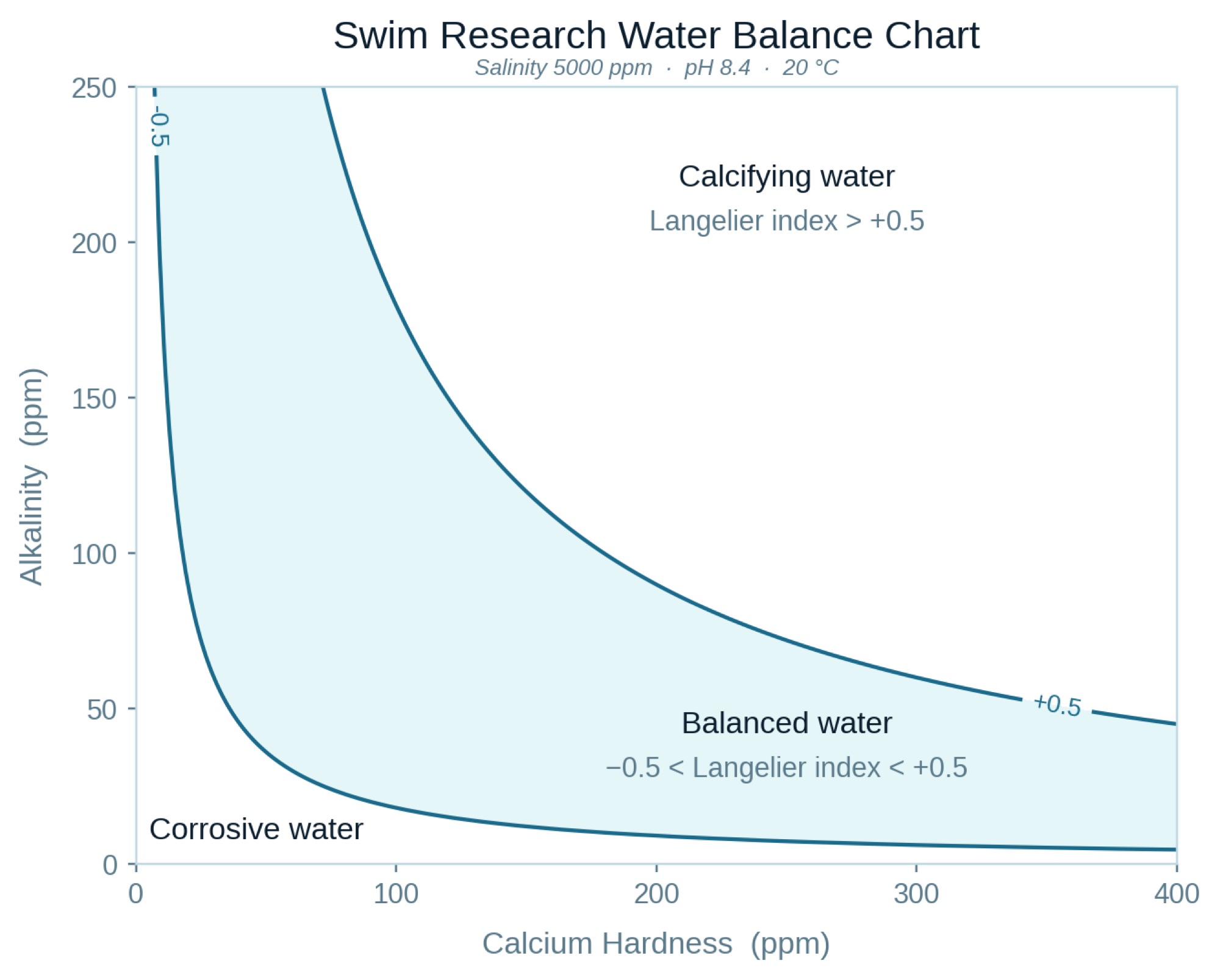
Swim Research Water Balance Chart
Additional
guidance.
Refilling a pool
If you are filling a pool with fresh water:
- Add salt as required by your chlorinator
- Add Catalyst and Conditioner
- Raise hardness to 150 ppm with calcium
- Raise alkalinity to 80 ppm with buffer
- If pH is above 8.5, lower to 8.0 with acid
Algae and superchlorination
Algaecides, flocculants, clarifiers and shock treatments can be applied as usual.