Bromine works at your
pool's natural pH.
Chlorine in pool water splits into an acid form and a base form. The acid form is a powerful disinfectant, but the base form is inactive. So you have to keep adding acid to keep chlorine in the acid form, or your pool will go green.
Unlike chlorine, the active form of bromine is stable at higher pH. Chlorine stops working if the pH goes above 7.8. But bromine keeps working all the way up to pH 9.
If you don't add acid your pool will settle at its natural pH of about 8.0–8.5. This is too high for chlorine but just right for bromine. With chlorine you have to keep adding acid. With bromine you just let your pool settle at its natural pH.
Bromine works
at high pH.
Active disinfectant fraction vs pH
Getting your chlorinator
to make bromine.
Your chlorinator makes chlorine by salt water electrolysis. Sodium chloride is converted into chlorine by an electric current.
Swim Research uses a catalyst, sodium bromide, that converts that chlorine into bromine. Sodium bromide is a salt that is naturally present in seawater, and we add it to your pool at the same concentration as it is in seawater.
As soon as your chlorinator makes chlorine, it immediately reacts with the catalyst to make bromine. The bromine eventually breaks down under sunlight, and reforms the catalyst, ready to start over again.
The catalyst is not consumed, it is just endlessly recycled between bromide and bromine. So we only need a tiny amount of catalyst, just a cup or two depending on pool size. And because it is not consumed it only needs to be topped up occasionally, about twice a year.
Natural water
balance.
Water balancing means adding chemicals to your pool to make sure that the water is saturated with calcium carbonate.
When the water is saturated with calcium carbonate it is said to be in balance.
If there is too much calcium carbonate it may form calcium deposits in your pool. If there is too little it may corrode concrete and grout.
At the pH of a chlorine pool, water can hold a lot of calcium carbonate. So you have to add a lot of calcium and carbonate buffer to achieve balance.
But you also have to add acid to keep the pH low, and acid destroys buffer. So you are constantly adding chemicals, fighting to keep water in balance.
Swim Research solves this with bromine and alkaline water. Calcium carbonate is not very soluble in alkaline water, so you need very little calcium and buffer to be in balance.
In fact you shouldn't need to add any at all. Carbon dioxide in the air dissolves in water to make carbonate buffer. There is enough calcium in tap water and enough buffer from the air to balance your pool.
And because you don't need to add acid, the pool is stable and naturally balanced — without adding any chemicals!
The Langelier index
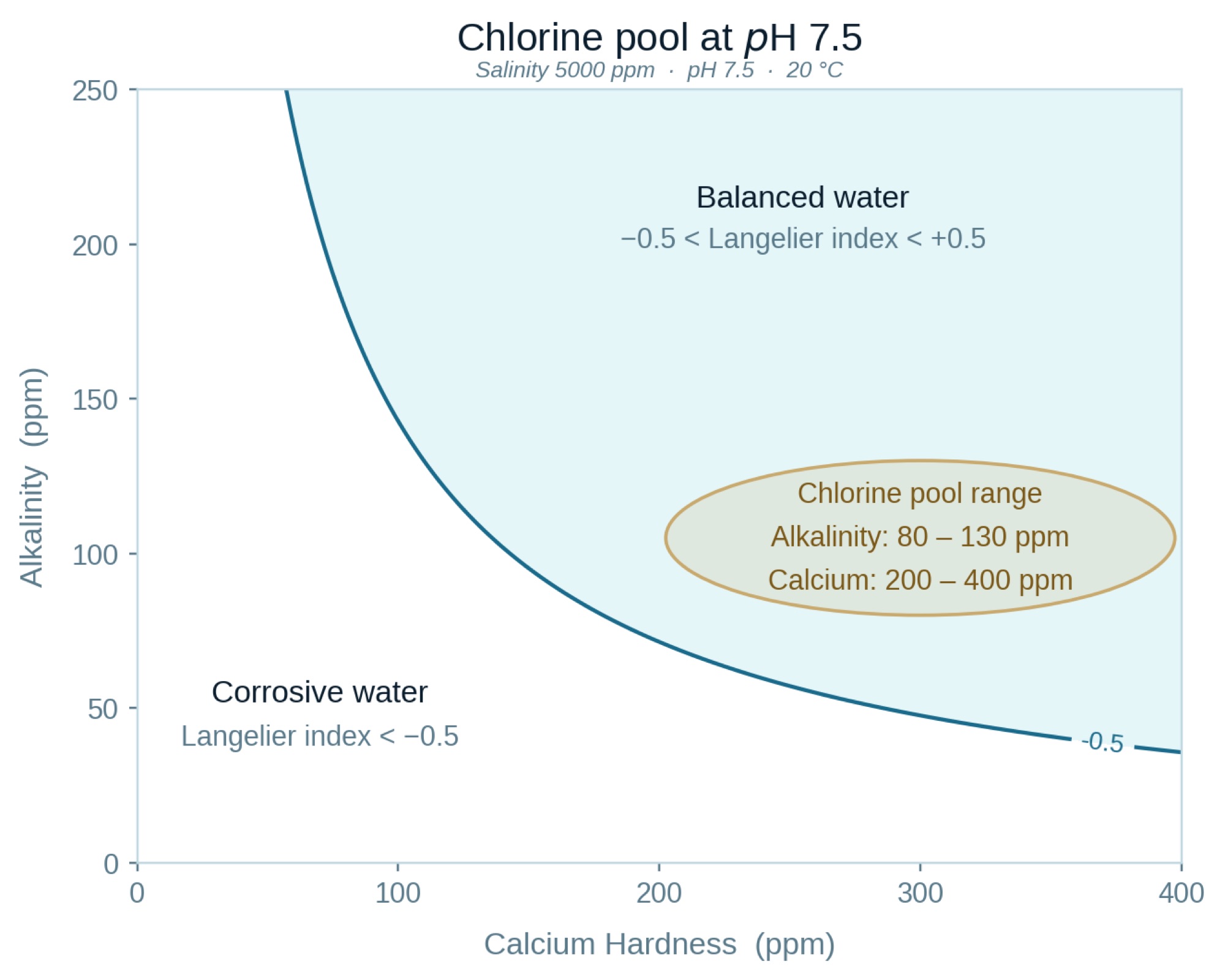
The Langelier index measures how much calcium carbonate is in your pool. Positive means too much, negative means too little, zero is just right. Water is in balance if the Langelier index is between −0.5 and +0.5.
The plot below shows the Langelier index for a chlorine pool, given the water alkalinity and calcium hardness. The shaded region is balanced water. The oval shows the recommended ranges for buffer and calcium. You have to keep adding buffer and calcium to stay in the shaded region, and acid to keep the pH around 7.5.
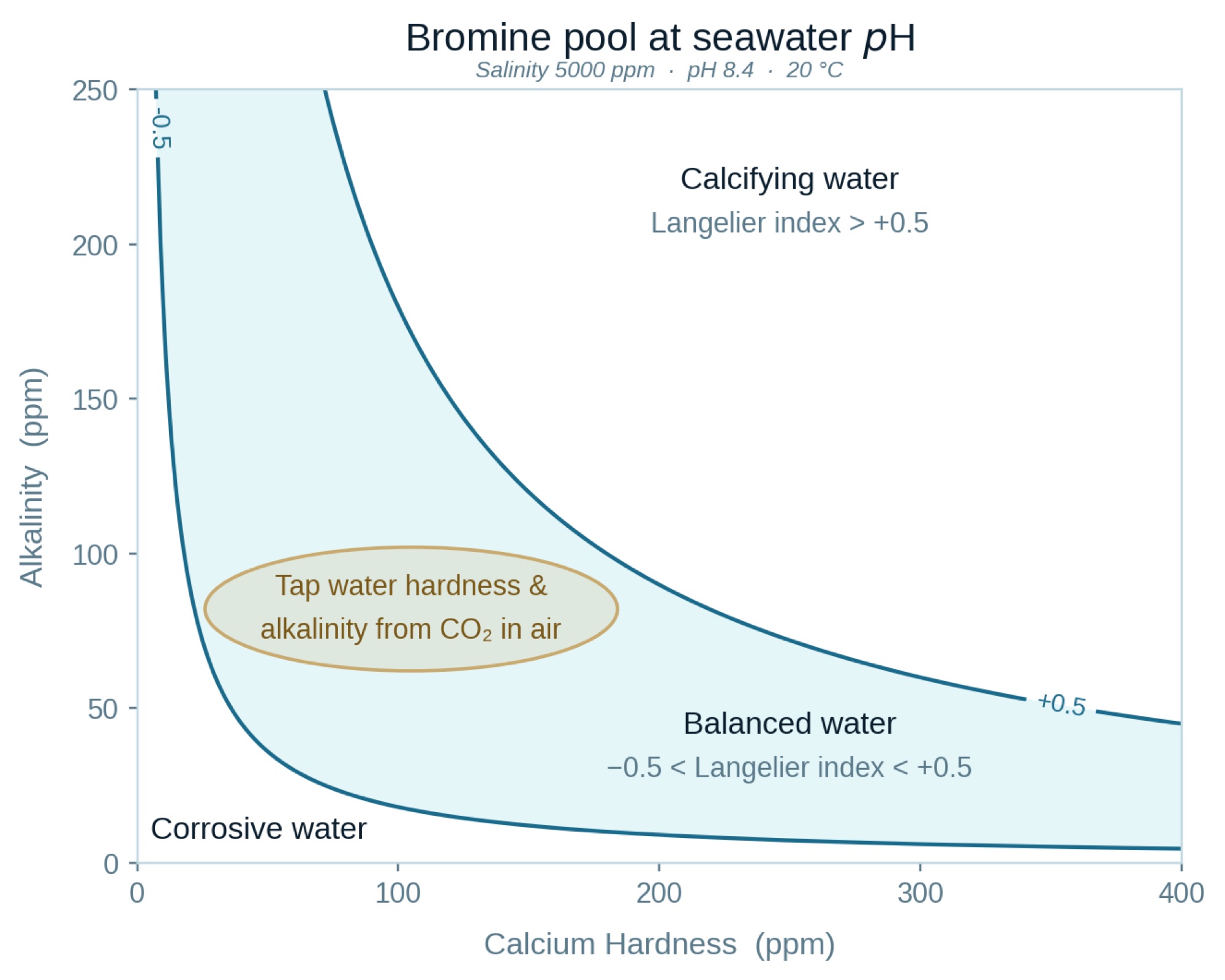
Compare this to a bromine pool at its natural equilibrium pH. The balanced water region has moved to lower alkalinity and calcium levels.
At these levels CO2 from the air dissolves in water to form buffer with an alkalinity of about 80 ppm. Australian tap water has around 30 to 180 ppm of calcium. So tap water itself is comfortably in the balanced water region.
This means that you don't need to add anything to balance your water. And the pH is stable at equilibrium, so you don't need to add acid. Everything is naturally in balance.
Zinc as a
phosphate remover.
Phosphates are an essential micronutrient for algae. Phosphates promote algae growth, and removing phosphates suppresses algae. Disinfection and phosphate removal work together to keep your pool free of algae.
Swim Research Conditioner is a zinc based phosphate remover that is designed to work in alkaline water. We include it with your dose of Catalyst.